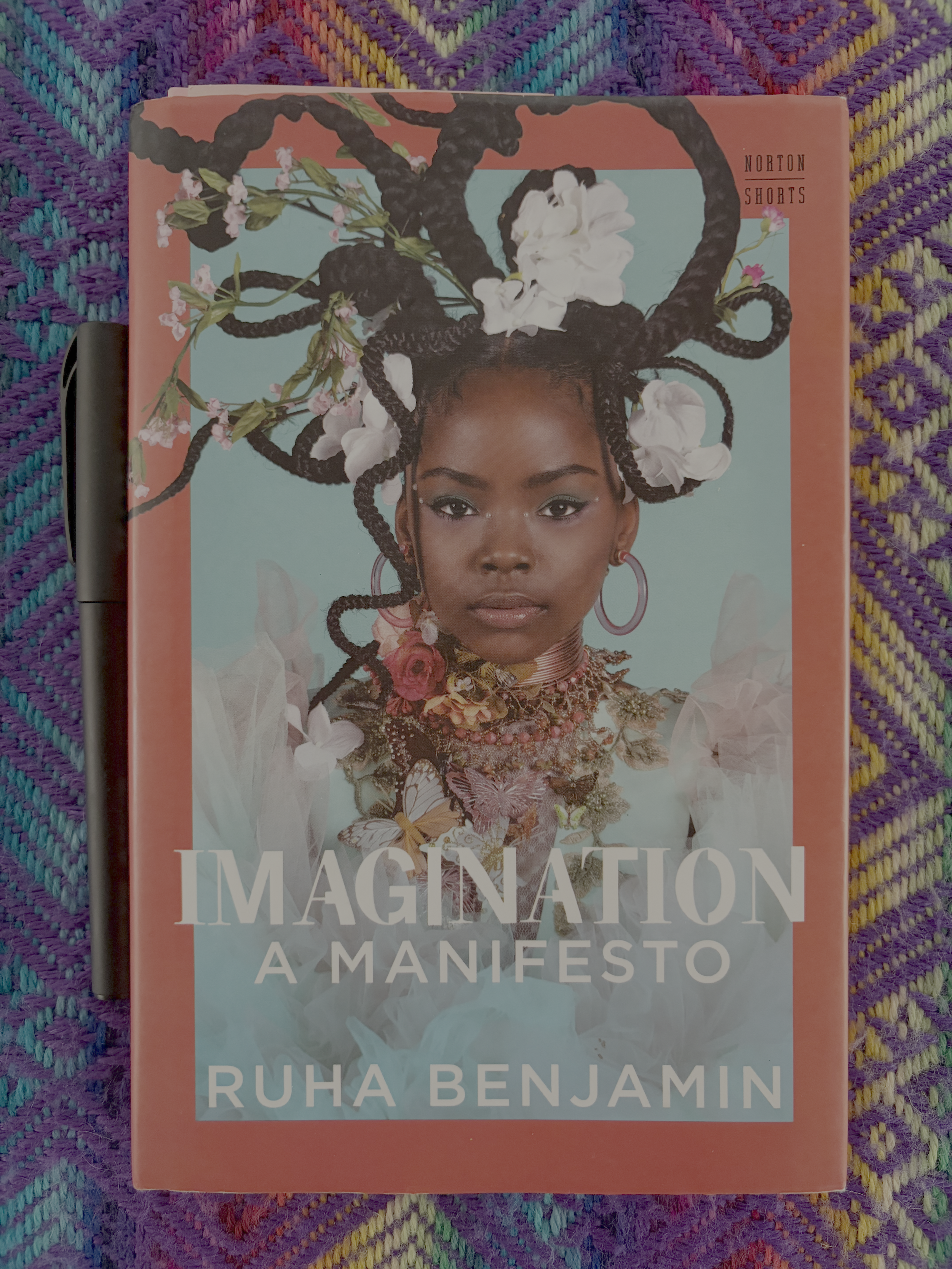
Book by Dr. Ruha Benjamin
When you first open Dr. Ruha Benjamin’s book Imagination: A Manifesto, the book cover introduces this writing as “her proclamation that we have the power to use our imaginations to challenge systems of oppression and to create a world in which everyone can thrive”. It is filled with a unique balance of realism and hope. Dr. Benjamin, who also wrote Race After Technology, doesn’t shy away from the hardships we face in today’s world. She warns us of technology and how it has embedded biases and mismatched values. But, with these warnings she also shares examples of how technology, built with community involvement, can be reimagined to unite us instead of divide us.
Throughout the book, Dr. Benjamin outlines examples of how imagination can help us build a better world together. She calls imagination “the invisible circuitry that connects the world out there to our inner worlds” (p.64), and explains that “our theories are the first draft of reality” (p.105). Dreaming is not a luxury; it is a prerequisite for change.
Through examples, she shows us the power of collective imagination and shared dreams. This book reminded me that our imagination is so uniquely human and a big part of what makes us so magical. One organization I learned about in this book is the CIVIC SQUARE’s Department of Dreams. Dr. Benjamin shares the definition of dreaming through the lens of this organizations’ work:
“Dreaming is a way of processing emotions and information and making connections by creating “vivid stories and extraordinary thoughts capes… making them a rich playground for our minds to test, to tackle different subjects, and to do ‘impossible’ things.” (p.108)
The call to action is clear: our imagination is powerful and we need to spend more time in collective dreaming in order to build the worlds we want to live in. I have started include “Dreaming” as a distinct phase in my projects. I try to take some extra time to write down the dream before discussing the barriers that exist.
I hope you can find ways to incorporate it in any action you’re taking right now, even if it’s just a 5 minute discussion or journal prompt.
If no barriers existed, what would you create?